

President Joe Biden and Chinese President Xi Jinping met for the first time in a year and reached an agreement on crisis management, including the restoration of military channels, but differences between the United States and China over economic sanctions such as export controls appear to persist.
President Joe Biden, who attended the Asia-Pacific Economic Cooperation (APEC) CEO Summit held in San Francisco on the 16th (local time), said, “We are de-risking and diversifying our economic relationship with China. He added, “We will take measures targeting areas necessary to protect our very important national security interests.” This is interpreted to mean that export controls in the artificial intelligence (AI) and advanced semiconductor sectors will be maintained.
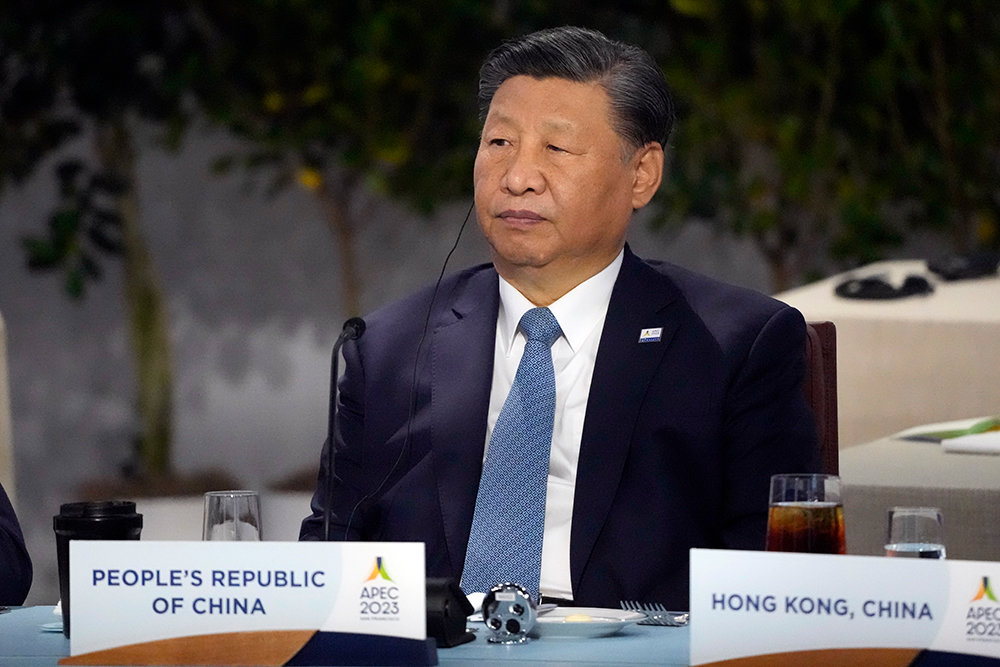 Chinese President Xi Jinping. 2023.11.16 (AP/Newsis)
Following the CEO dinner the previous day, President Xi actively sought to attract investment at the event, saying, “We will take ‘warm’ measures to encourage investment from overseas businessmen.” At the same time, he said to the United States, “The Asia-Pacific region should not become an arena of geopolitical competition. “Disrupting the supply chain is in no one’s interest,” he emphasized. They once again requested that the United States lift export controls on China.
The New York Times quoted a source as saying, “During the U.S.-China summit, President Xi complained that China is suffering a lot from the U.S. portraying China as a villain,” adding, “In particular, the most time was devoted to export controls.” It was also reported.
The NYT added that this means that a subtle power shift is occurring in the delicate US-China relationship. This means that China, which is suffering from headaches such as yuan devaluation and economic slowdown due to the exodus of U.S. investment in China, has something to gain from the U.S. in the tense relationship between the two countries. President Xi’s avoidance of hard-line ‘war diplomacy’ rhetoric and his mention of ‘panda diplomacy’, a symbol of exchange, are also interpreted as an attempt to ‘woo’ investors.
Due to the United States’ strong export controls, Chinese information technology (IT) companies are blocked from expanding their business. Alibaba, China’s largest e-commerce company, announced on the 16th that it would withdraw its cloud division spin-off plan due to U.S. semiconductor export controls. Alibaba’s stock price plunged 9.14% on the New York Stock Exchange, where it is listed, and fell more than 10% on the Hong Kong Stock Exchange on the 17th. At least about $20 billion (about 26 trillion won) in market cap evaporated.
New York =
Source: Donga

Mark Jones is a world traveler and journalist for News Rebeat. With a curious mind and a love of adventure, Mark brings a unique perspective to the latest global events and provides in-depth and thought-provoking coverage of the world at large.