

On the afternoon of the 26th, the Nurimaru APEC House conference hall in Haeundae-gu, Busan. The foreign ministers of Korea, China, and Japan left the conference room immediately after completing the meeting, which lasted about 1 hour and 40 minutes. South Korea’s Foreign Minister Park Jin, the chairman, sent off Japan’s Foreign Minister Yoko Kamikawa and China’s Foreign Minister Wang Yi, a member of the Central Political Bureau of the Communist Party of China.
It was the first time in four years and three months that the foreign ministers of the three countries gathered in one place for a meeting. However, the joint press conference held by the three countries to announce the results of the meeting was canceled. It was a different scene from the three countries’ ministers standing side by side and announcing the results of the meeting immediately after the meeting of the foreign ministers of Korea, China and Japan held in Beijing in August 2019. This meeting was held to discuss the schedule for the Korea-China-Japan summit, but there was no official announcement of the schedule following the meeting between the foreign ministers of Korea, China and Japan.
At the foreign ministers’ meeting held on the 26th, the three countries, Korea, China and Japan, decided to hold the next stage, a trilateral summit, at the ‘earliest mutually convenient time’ and decided to speed up preparations. However, as it has become difficult to hold the Korea-China-Japan summit within the year, which Korea, the chair country, had hoped for, it is reported that the government is pushing to hold the Korea-China-Japan summit in the first half of next year.
An official from the Ministry of Foreign Affairs said, “(So far) there has been no agreed upon date and time for the summit,” and “We are communicating with various plans.” As China has recently shown a somewhat passive attitude toward Korea-China-Japan foreign ministers’ meetings and summits, there is also speculation among diplomats that it may take longer for the actual summit to be held.
The foreign ministers of the three countries spoke with one voice about the importance of cooperation. Minister Park said, “Trilateral cooperation has been difficult for a while due to various circumstances, including COVID-19,” and added, “At today’s meeting, we agreed to quickly restore and normalize trilateral cooperation.” Minister Park proposed promoting the future generation exchange project as a key cooperation project between Korea, China and Japan, and China and Japan also agreed to this, a Ministry of Foreign Affairs official said. Korea, China, and Japan agreed to continue communication at all levels to resolve the North Korean nuclear issue.
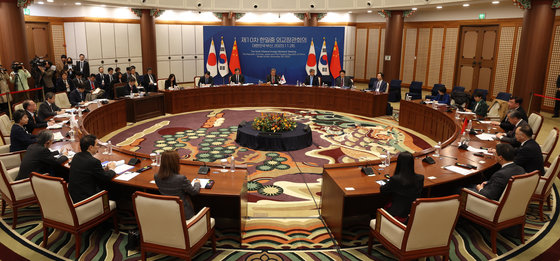 Foreign Minister Park Jin, Japanese Foreign Minister Yoko Kamikawa, and Chinese Foreign Minister Wang Yi are holding a meeting of foreign ministers of Korea, Japan, and China at Signiel Busan in Haeundae-gu, Busan on the afternoon of the 26th. 2023.11.26 News 1
 It is known that the Ministry of Foreign Affairs of Korea, which chairs this Korea-China-Japan Foreign Ministers’ Meeting, initially planned a joint press conference and a friendly dinner for the three ministers. However, Director Wang Yi notified of the shortening of the schedule, and as Director Wang’s return schedule was postponed, it was reported that it was decided not to hold a joint press conference or dinner. Director Wang returned home immediately after completing the meeting that day. A diplomatic source said, “China did not give a definite answer until the last minute on when Director Wang Yi could attend the Korea-China-Japan foreign ministers’ meeting.”
Regarding Director Wang’s decision to return home early, in effect refusing to hold a joint press conference and dinner, some analysts say that “China has shown signs of discomfort with Korea and Japan’s strengthening solidarity with the United States.” Some point out that China, which had been actively reaching out to Korea and Japan as the U.S.-China conflict intensified, changed its attitude from Korea-China-Japan cooperation to a more passive direction as recent U.S.-China dialogue continued.
Korea, China, and Japan did not even adopt a joint press statement after completing this meeting. The foreign ministries of the three countries each presented data summarizing the results of the meeting. An official from the Ministry of Foreign Affairs explained, “After the summit, a result document (containing the common position of each country) is issued, but there is no certain custom at the foreign ministers’ meeting.”
Minister Wang and Foreign Minister Kamikawa did not pay a courtesy visit to President Yoon Seok-yeol during this visit to Korea. This is different from the previous visit to Korea in March 2015 on the occasion of the Korea-China-Japan Foreign Ministers’ Meeting, where then-Japanese Foreign Minister Fumio Kishida visited the Blue House and paid a courtesy visit to then-President Park Geun-hye. In a phone call with the Dong-A Ilbo on the 26th, a senior government official said, “Director Wang’s visit to President Yoon was not promoted in the first place,” adding, “This was because the Korea-China-Japan Foreign Ministers’ Meeting was held in Busan and Director Wang’s schedule was tight.”
Source: Donga

Mark Jones is a world traveler and journalist for News Rebeat. With a curious mind and a love of adventure, Mark brings a unique perspective to the latest global events and provides in-depth and thought-provoking coverage of the world at large.