

As the war has continued for nearly two years and the situation has reached a stalemate, Russian President Vladimir Putin and Ukrainian President Volodymyr Zelensky have engaged in an off-site public opinion war against the international community and their own citizens. When President Putin emphasized Russia’s defense capabilities and at the same time tried to shake up Ukraine, saying, “(if the West wants) we will negotiate according to national interests,” President Zelensky held a counter-press conference and dismissed the possibility of peace talks, criticizing the Western bloc, including the United States. Aid was requested.
According to Reuters, President Putin attended the Ministry of Defense board meeting discussing next year’s plan on the 19th and said, “I have no intention of giving up the goal of special military operations (Russian expression for the war in Ukraine).” He made it clear that he would continue the war next year.
Even when awarding medals to veterans, he emphasized, “We are upgrading our nuclear weapons and maintaining the highest level of military readiness.” Russian Defense Minister Sergei Shoigu, who was present with President Putin, emphasized his country’s military power, saying that since February of last year, Russia’s weapons production has increased 5.6 times for tanks, 16.8 times for unmanned aerial vehicles (Drones), and 17.5 times for artillery shells.
At the same time, President Putin said that if Ukraine, the United States, and the West want to negotiate, he will respond. Analysis suggests that this was a remark with the possibility of former U.S. President Donald Trump, who had shown negative support for Ukraine in the U.S. presidential election in November next year, coming back to power. Reuters said, “Putin is waiting for the results of the US presidential election.”
On the same day, President Zelenskyy held a press conference lasting about two hours in the capital Kiu and launched a rebuttal. “With regard to the war, Russia has not achieved any results this year,” he said, emphasizing that “if Ukraine does not lose its resilience, the war can end sooner.” He went on to reveal that “he had received a suggestion from the military leadership that there was a need to mobilize an additional 500,000 troops.” This means that there will be no backing down despite some observations that the situation has become unfavorable.
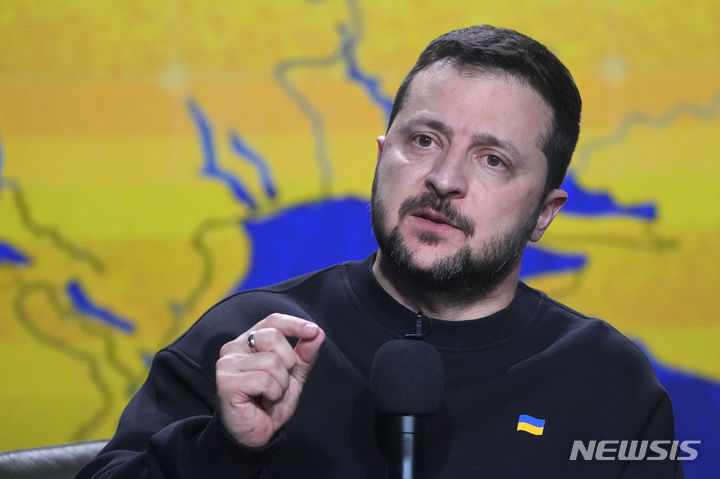
He also dismissed peace talks with Russia as “currently not feasible.” At the same time, he said that he was preparing a proposal that Russia would not accept, such as ‘withdrawal of Russia’s troops from Ukrainian territory’, and that he would convey this to Russia. Regarding the growing skepticism about support for Ukraine in the United States and the European Union (EU), he again called for aid, saying, “I firmly believe that the United States will not betray war-affected countries, and I am also grateful for our relationship with the EU.”
According to the Washington Post (WP) on this day, the United States is pursuing a plan to first provide urgently needed Patriot anti-aircraft missiles to Ukraine and procure the shortfall from Japan. Recently, as the opposition party, the majority party in the U.S. House of Representatives, grew louder and the US$61.4 billion (approximately KRW 81 trillion) support budget for Ukraine was not passed, the government attempted to provide indirect support through allies.
The Japanese government is considering exporting Patriots manufactured domestically to the United States by revising the ‘3 Principles of Defense Equipment Transfer’ and operating guidelines as early as the 22nd. The export targets are the new Patriot Missile 3 (PAC-3) and the older Patriot Missile 2 (PAC-2). It has been reported that export discussions have progressed in that the Patriot missile is for defense purposes to intercept enemy attacks. A U.S. official told WP, “Japan’s change in defense equipment export regulations is in response to a key request from the Joe Biden administration.”
If Japan’s support for Patriot missiles is provided, pressure could also increase on Korea, which provided ‘diversionary support’ of hundreds of thousands of rounds of 155mm ammunition to the United States. After providing ammunition to Ukraine, the U.S. government made up the shortfall with exports from Korea. In the case of 155mm artillery shells, since they are offensive weapons, it is difficult for the Japanese government to export them, so there is speculation that additional support requests from Korea may continue.
Source: Donga

Mark Jones is a world traveler and journalist for News Rebeat. With a curious mind and a love of adventure, Mark brings a unique perspective to the latest global events and provides in-depth and thought-provoking coverage of the world at large.