

The ruling Democratic Progressive Party has 51 seats and the Kuomintang has 52 seats.
Both sides desperately need cooperation from the People’s Party for 8 seats
Ahead of the election of the Speaker of the National Assembly on the 1st of next month
People’s Party, interested in which side to support
“Taiwan’s ruling Democratic Progressive Party (Democratic Progressive Party) has a president-elect with low approval ratings, and has fallen from the largest party in the Legislative Yuan (National Assembly) to the second largest party, falling into a ‘double minority.’”
This is local media Lian Hebo’s assessment of the results of the Taiwanese presidential election and the Legislative Council (National Assembly) election held on the same day as the Taiwan presidential election on the 13th. The Democratic Progressive Party won the presidential election that day, but President-elect Lai Qingde received only 40.1% of the vote. The Democratic Progressive Party’s seats in the Legislative Yuan also decreased by 10 compared to four years ago, giving up its position as the largest party in the National Assembly to the main opposition party, the People’s Party. This is the first time in 16 years that the ruling party’s seats fell short of the majority (57 seats) in the Legislative Yuan, which has a total of 113 seats, since 2008, when the current seats were confirmed. After the direct election system was introduced in the 1996 presidential election, the formula in which the Democratic Progressive Party and the National Party took turns in power for eight years from 2000 to the present was also broken.
Although the Kuomintang was ranked as the largest party, it is still uneasy as it only has one more seat than the Democratic Progressive Party. Both the Democratic Progressive Party and the People’s Party desperately need cooperation from the third party, the People’s Party, which won eight seats, to ensure stable operation of the National Assembly.
Accordingly, attention is being paid to which party’s candidate the People’s Party will support when the Legislative Yuan (National Assembly Speaker) is elected on the 1st of next month. As candidates for the head of the Legislative Yuan, the Kuomintang Party’s former Kaohsiung mayor Han Kuo-yu (67, photo), who is running in the 2020 presidential election and causing various controversies, and the Democratic Progressive Party’s current Legislative Yuan Shikun (游錫堃) are mentioned.
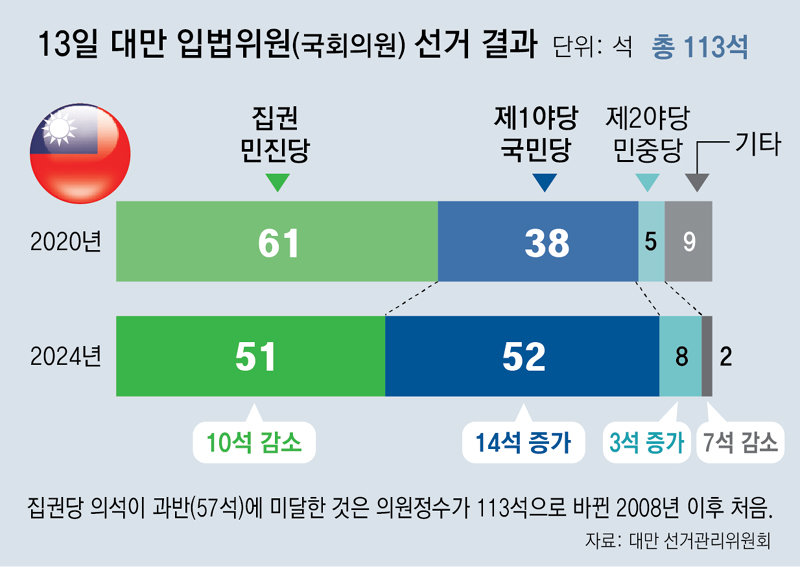
The National Party, which failed to achieve a change of government after losing in the presidential election, won 52 seats in the 11th Legislative Council election on the 13th. There are 14 more seats than four years ago. On the other hand, the Democratic Progressive Party, which won the presidency, lost 10 seats and won only 51 seats. The People’s Party’s seats increased from 5 four years ago to 8.
The victory of the National Party in the legislative election was predicted to some extent from pre-election opinion polls. Unlike the presidential election, where personality is emphasized, in the Legislative Yuan election, the ability of each candidate to manage his/her constituency is important, even if national recognition is low. There was also considerable voter dissatisfaction that the Democratic Progressive Party had been lukewarm in resolving people’s livelihood issues due to its emphasis on anti-China policies during the eight years of ‘hardliner against China’ President Tsai Ing-wen’s rule.
Taipei citizen Li Yi-rui (李依叡, 36, office worker) told Dong-A Ilbo reporters on the 12th, “I support candidate Lai in the presidential election because I am concerned about military threats from China, but I will vote for the Kuomintang candidate in the legislative election.” He said that the National Party candidate does a better job than the Democratic Progressive Party candidate and is more knowledgeable about the situation in the constituency.
In the November 2022 local government election, the Democratic Progressive Party won only 5 out of 21 regions, suffering a crushing defeat to the People’s Party, which won in 13 regions. This trend continued in this legislative election. During this campaign, President Tsai appealed to vote for both President-elect Lai and the Democratic Progressive Party’s legislative committee members, saying, “Legislative members are the driving force of state administration,” but it was ineffective.
There is great interest in whether former Mayor Han Kuo-yu, who has been attracting attention by causing various controversies, will become the head of the Legislative Council. He entered the Legislative Yuan as the first proportional representation candidate for the People’s Party in this election.
Former mayor Han attracted great attention in 2018 when he became mayor as a member of the Kuomintang in southern Kaohsiung, which is considered the Democratic Progressive Party’s stronghold. He invited supporters who, like him, were also bald, to the campaign site and performed a unique performance that emphasized his baldness. He gained momentum and became the Kuomintang’s presidential candidate in 2020, but was defeated by President Tsai due to excessive pro-China tendencies. In June of the same year, an election was held to dismiss the mayor on the grounds that he “neglected municipal affairs while focusing only on the presidential election,” and he was stripped of his mayoral position.
In order for him to become the head of the Legislative Yuan, he desperately needs the support of the People’s Party, which did well in both the presidential election and the Legislative Yuan election. On the 13th, People’s Party Chairman Ke Wen-je (柯文哲), who ran in this presidential election, announced that he would reveal the candidate he supports on the 15th, saying, “The People’s Party makes collective decisions, not my one-man party.”
Taipei =
Source: Donga

Mark Jones is a world traveler and journalist for News Rebeat. With a curious mind and a love of adventure, Mark brings a unique perspective to the latest global events and provides in-depth and thought-provoking coverage of the world at large.