

Trump likely to be Treasury secretary if he comes back to power
“Comparative advantage in trade is created through industrial policy, subsidies, and trade regulations.”
Trump makes a series of protectionist promises
U.S. conservative experts also expressed concerns
“Korea is competitive in steel production, but this is entirely the result of (Korean) government policy.”
Former U.S. Trade Representative (USTR) Robert Lighthizer, who is considered a ‘key economic adviser’ to former U.S. President Donald Trump, cited Korean steel as an example to advance protectionist arguments on the 13th (local time). It is argued that the government’s all-round support was behind Korea’s rise to the world’s highest level of steel industry even though it did not have cheap electricity, iron ore, or other natural advantages.
Former Representative Lighthizer said in “After Free Trade,” which he contributed to the foreign affairs magazine Foreign Affairs, “Comparative advantage in trade is created through industrial policy, subsidies, and trade regulations.” Former President Trump signaled his intention to further strengthen the protectionist trade and high tariff policies of his first term in order to revive the US manufacturing industry if he returns to power in the US presidential election in November. If Trump wins, a heated debate continues in the conservative camp in the United States over the protectionism he has fueled, as he is considered a strong candidate for Treasury Secretary in the next administration.
Former Representative Lighthizer led the hard-line policy against China during the first Trump administration and is in charge of the trade sector in preparing plans for Trump’s second term in office. For this reason, ‘No Trade Is Free’, which he published in June last year arguing that high tariffs and trade barriers are necessary, has become a book that attracts the attention of trade officials not only in the United States but also in other countries.
In a contribution to Foreign Affairs, in response to criticism of this book, he said, “US trade policy should contribute to helping US workers find and keep well-paying jobs.” At the same time, he criticized, “The free trade policy that the United States has implemented for decades has focused only on corporate profits,” adding, “As a result, millions of jobs have been lost and a trade deficit of trillions of dollars has accumulated.”
Former CEO Lighthizer said, “Comparative advantage in trade is entirely the result of government policy,” and cited the Korean steel industry and Taiwan’s semiconductor industry as representative examples. He referred to Taiwan’s TSMC, the world’s No. 1 semiconductor foundry (consignment manufacturing) company, and claimed, “Thanks to the subsidies and tax cuts from the Taiwanese government.” He said, “We can increase the competitiveness of the U.S. manufacturing industry through national intervention,” and emphasized the need to strengthen protectionism like former President Trump’s “America First” policy.
Former President Trump has already made unconventional protectionist pledges, such as abolishing most-favored-nation treatment for China and imposing a universal basic tariff of 10%. Former Representative Lighthizer’s recent remarks suggest that this stance may be further strengthened in future trade pledges.
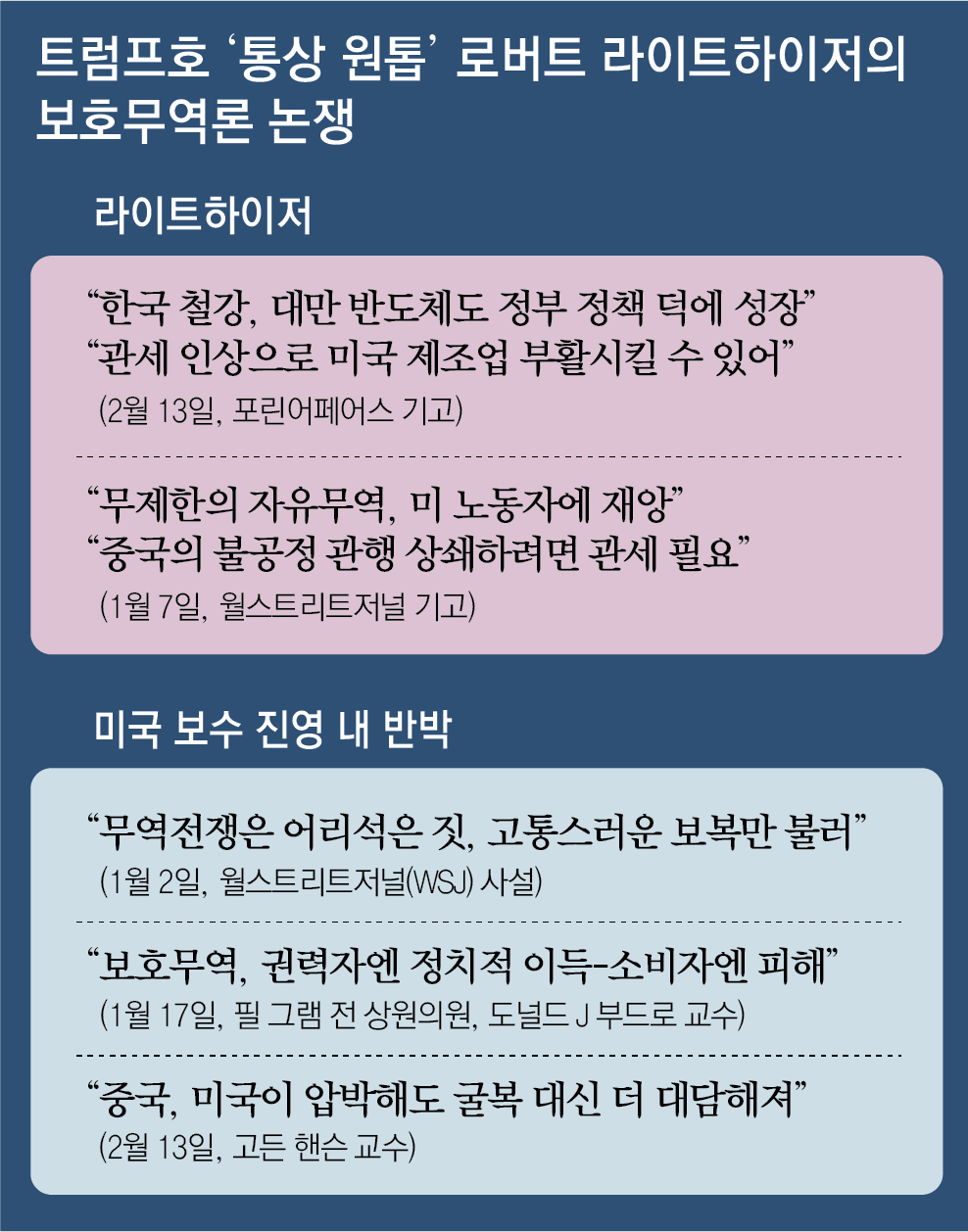
Former Representative Lighthizer’s claims sparked a heated debate within the conservative camp. The Wall Street Journal (WSJ), a conservative economic media outlet, directly targeted him in its first editorial of the new year on January 2, saying, “The trade war is foolish and will only bring about painful retaliation.” Former Republican Senator Phil Gramm and liberal George Mason University professor Donald J. Boudreau pointed out in a joint article a week later that protectionist trade causes rising prices, harming millions of consumers.
Gordon Hanson, a professor at Harvard University’s Kennedy School and an expert on the Chinese economy, also pointed out the adverse effects of protectionism through Foreign Affairs on the 13th, saying, “Instead of giving in to pressure from the United States, China is responding with bolder trade.” He also refuted, “Taiwan’s semiconductor competitiveness is the result of massive investment in higher engineering education rather than subsidies or tax breaks.”
Kent Lassman, who supported free trade in ‘Project 2025,’ a policy report produced by the conservative think tank Heritage Foundation, said, “Trump believes more strongly than ever that ‘America is being sacrificed,’” and former Representative Lighthizer and others. Hawkish advisers analyzed that they would take advantage of this belief.
Source: Donga

Mark Jones is a world traveler and journalist for News Rebeat. With a curious mind and a love of adventure, Mark brings a unique perspective to the latest global events and provides in-depth and thought-provoking coverage of the world at large.