

[위기극복의 새 길, 신중동]〈4〉 HD Hyundai opens new Middle East route for shipbuilding industry
K Shipbuilding, learned in England, exports technology to the Middle East for the first time… Saudi Arabia’s IMI Shipyard begins operations by the end of this year
Solid trust based on port construction in 1976… Expansion of new business opportunities in engines and construction machinery
King Salman Shipbuilding Industrial Complex located near Jubail, eastern Saudi Arabia, on the 5th (local time). The final installation work for the 1600-ton Goliath crane, the ‘symbol of the shipyard’, was in full swing. As the large crane came up, it was immediately apparent that this was a shipyard, even from a distance. This place, the size of 700 soccer fields and where 12,000 workers come and go every day, is the ‘IMI Shipyard’ being built by HD Hyundai in collaboration with Saudi state-owned company Aramco, United Arab Emirates (UAE) energy company Lamprel, and Saudi state-owned shipping company Bahri. . Currently, the process is about 80% complete. The remaining three large cranes are scheduled to be installed and begin operation at the end of this year.
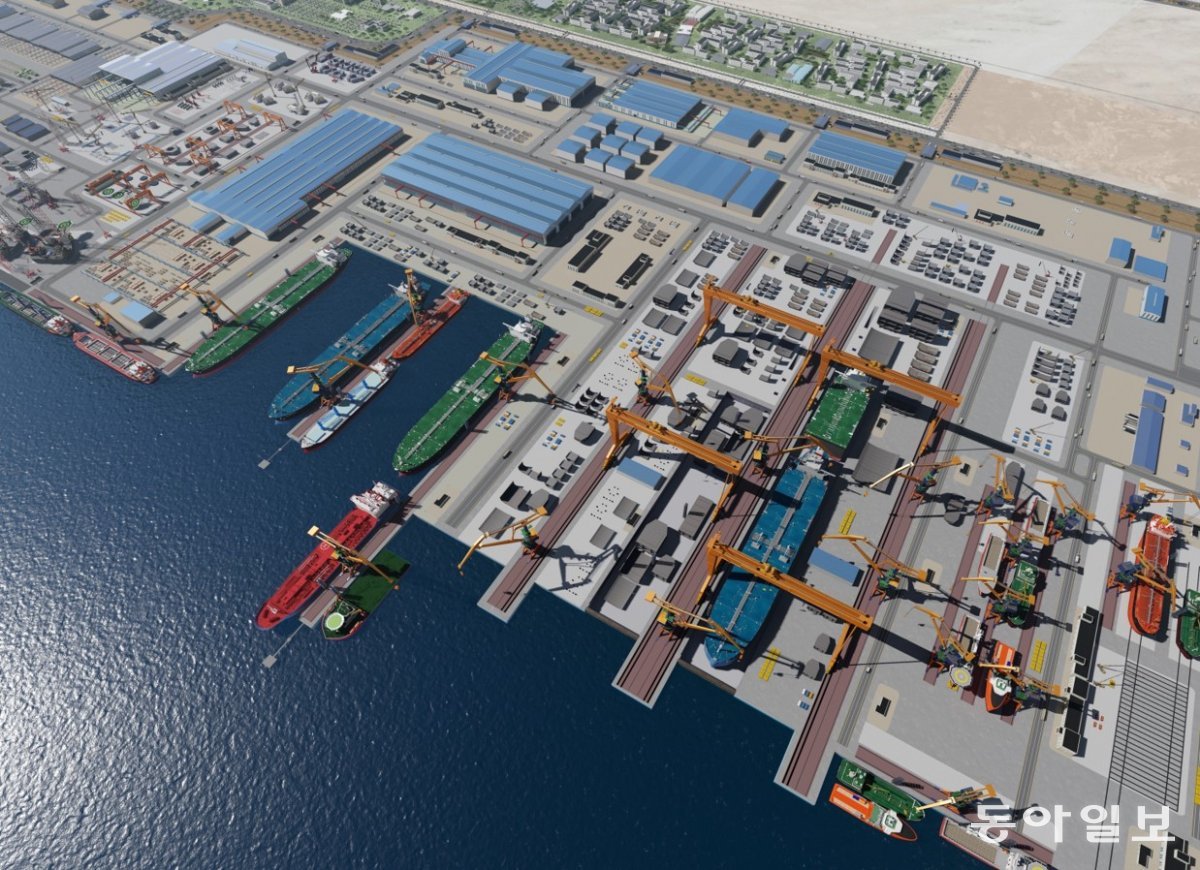 View largerA projected aerial view of the IMI shipyard, which is scheduled to be completed by the end of this year and will be the size of 700 football fields. Jubail =
 IMI Shipyard is the first case in the history of the Korean shipbuilding industry to export design technology in the form of a license. HD Hyundai signed a technology licensing agreement in 2019 and receives a licensing fee for each merchant ship built at the IMI shipyard. Previously, in 1971, HD Hyundai entered the shipbuilding industry in earnest by leasing the design drawings of two 260,000-ton crude oil carriers (VLCCs) from British shipbuilding company Scott Leesgo and building the ships through a licensing method. HD Hyundai, which has since risen to number one in the world, has now pioneered a new market by exporting its ship design technology to the Middle East for the first time in half a century.

The investment cost of the IMI shipyard alone amounts to 5 trillion won. Saudi Aramco invested 40%, and HD Hyundai has a 20% stake. This is the second overseas shipyard built by HD Hyundai, following Vietnam. A total of 4 Goliath cranes will be built at 3 docks, and 7 quays (wharf facilities for shipping produced ships) will be built, with plans to build more than 40 ships per year.
Additional synergies are also expected with Bahri, a joint venture that holds a 20% stake in IMI Shipyard. HD Hyundai Heavy Industries has already received orders for 10 VLCCs from Bahri, and HD Hyundai Mipo Dockyard has received orders for 10 petrochemical carriers (PC ships) in 2020. It is expected that additional orders will be possible once the IMI shipyard is completed.
IMI Shipyard has had a long-standing relationship with Korea. In the past, Jubail was just an ordinary, small fishing village. However, in 1976, Hyundai Engineering & Construction, led by the late Hyundai Group founder Chung Ju-young, built the Jubail New Port, which was called the ‘largest construction project of the 20th century.’
About 40 years later, in 2015, HD Hyundai and Aramco signed a memorandum of understanding (MOU) with the main content of establishing a strategic partnership. The representative result is the IMI Shipyard. Vice Chairman Jeong Ki-seon, who was the head of the planning department at the time, personally took care of everything from MOU planning to signing. Ahn Yun-hyo, head of HD Hyundai Saudi Arabia, who met near the King Salman Shipbuilding Industrial Complex on this day, said, “For local residents, Jubail is a modern and Korean city, and they are very welcoming of the construction of a shipyard.”
The background of HD Hyundai exporting shipbuilding technology to the Middle East is closely related to the aggressive de-oil policies of Middle Eastern countries. In order to realize the ‘Vision 2030’ project led by Crown Prince Mohammed bin Salman, the Saudi government set the goal of reducing dependence on the oil industry and increasing the proportion of new and renewable energy. As the world declared carbon neutrality, it arose from the crisis that the oil industry alone could not guarantee the country’s future. An HD Hyundai official said, “Saudi Arabia is intensively nurturing the manufacturing industry to diversify its economic structure and increase domestic production.” He added, “With China dominating the shipbuilding industry based on low-priced orders, HD Hyundai is developing new technologies through technology licensing through super-gap technology. “We will create a profit structure,” he explained.

HD Hyundai diversified its business groups based on a relationship of trust through the Jubail Port construction, which amounted to a quarter of Korea’s national budget (approximately 940 million dollars). In addition to the shipbuilding industry, we are also looking for business opportunities in machinery fields such as engines, construction equipment, and transformers.
Right next to the IMI site visited on the 5th, work on establishing a factory for Makin, a marine engine joint venture that began construction in June of last year, was also in full swing. Makin is a joint venture jointly invested by HD Hyundai, Aramco, and Saudi Arabian Industrial Investment Corporation Dusur. Hak-gon Kim, senior manager at HD Hyundai, who has been in charge of field management for 5 years, said, “In the Saudi government’s business diversification process, we chose a partnership with HD Hyundai, which has built trust in the local area for over 50 years,” and added, “As part of Saudiization (localization in Saudi Arabia), we have chosen to partner with HD Hyundai. “Saudi officials are also very interested in helping us learn modern technology,” he said.
HD Hyundai also participated in the Saudi Neom City construction project. Last year, HD Hyundai received orders for about 1,900 construction machines from the Saudi market. The number of orders increased by about 20% compared to last year. Among these, Neom City is estimated to account for about 60-70%. The Saudi construction market is expected to grow by 5% annually until 2027. Neom City, which is scheduled to be completed in 2030, is expected to have expanded opportunities for orders, with more than 6,000 pieces of construction equipment being used last year alone.
HD Hyundai Electric, HD Hyundai’s power equipment affiliate, also won orders worth about $600 million (about 790 billion won) from Saudi Arabia last year. Representative examples include a contract to supply transformers worth 67.8 billion won to be supplied to Neom City in September of last year and power equipment supply with Saudi Arabian transmission and substation company Al-Hajj in October of last year. Sangman Han, senior manager at HD Hyundai Electric, said, “Middle Eastern countries are focused on oil-centered primary industries, so their manufacturing base is still poor, so exports from Korean manufacturing companies are expected to increase,” adding, “Given that power equipment is being built in the Middle East, which has many deserts. “Saudi Arabia wants high-quality products, so Korean companies have a quality advantage over Chinese companies,” he said.
Jubail =
Source: Donga

Mark Jones is a world traveler and journalist for News Rebeat. With a curious mind and a love of adventure, Mark brings a unique perspective to the latest global events and provides in-depth and thought-provoking coverage of the world at large.