
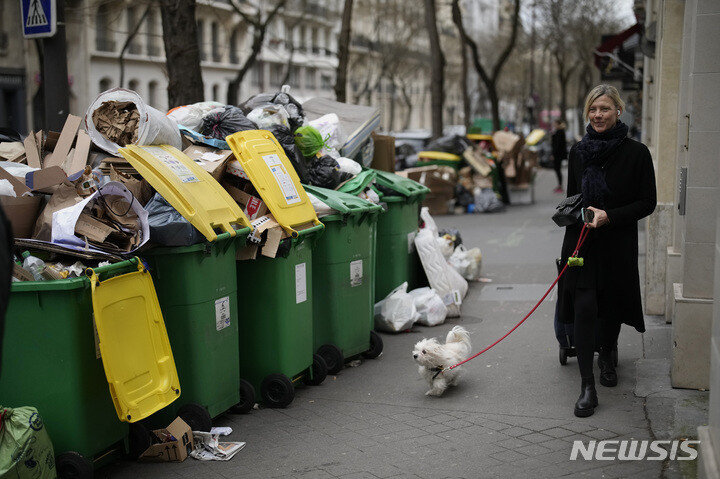
Until now, it has been disposed of as general waste… 5.4 million tons per year: incineration and landfill
Authorities “It is difficult to incinerate due to too much moisture, and methane gas is generated when landfilled.”
Local media: “We should move forward by referring to the example of Korea, a model country”
As France, the ‘country of gourmet food’, mandated separate disposal of food waste starting this year, attention was also drawn to the waste disposal methods of Korea, the ‘powerhouse in separate collection’.
From January 1 of this year, France began to separate food waste from general waste at all homes and businesses in accordance with Europe’s ‘Basic Waste Directive’ and France’s ‘Waste Prevention Act for Circular Economy (AGEC)’.
Until now, France treated food waste as general waste. Every year, one-third of all general waste, or 83 kg per person, or a total of 5.4 million tons of food waste, were disposed of through incineration or landfill.
In response, the French government explained that incinerating moisture-rich food waste is a waste of energy, and that landfilling food waste generates methane gas during the decomposition process, causing environmental pollution.
Authorities expect to reduce greenhouse gases by more than 800,000 tons every year through separate disposal of food waste.
In response to this change, the French media shed light on Korea. The food waste separation system has been implemented for over 20 years since 1998, and is said to be a ‘best practice’ with the current bio-waste recycling rate close to 100%.
France 24, BNN France, etc. introduced the method of separating food waste from Korean homes and businesses and related policies. They focused on mechanical food waste bins that automatically levy taxes and reported that Korea is “taking the lead in solving the increasingly serious food waste problem through ingenious ideas.”
The media then pointed out that there are some areas where separate disposal has not yet begun due to delays in the installation of food collection bins by local authorities. They cited the example of Korea and suggested the direction in which France’s waste policy should move.
However, unlike Korea, France included ‘green waste’ such as fruit and vegetable peels, animal and fish bones, egg shells, tea leaves, and fallen leaves in the category of food. In Korea, peels of onions and garlic, tea leaves, bones, and egg shells are disposed of as general waste.
Source: Donga

Mark Jones is a world traveler and journalist for News Rebeat. With a curious mind and a love of adventure, Mark brings a unique perspective to the latest global events and provides in-depth and thought-provoking coverage of the world at large.


